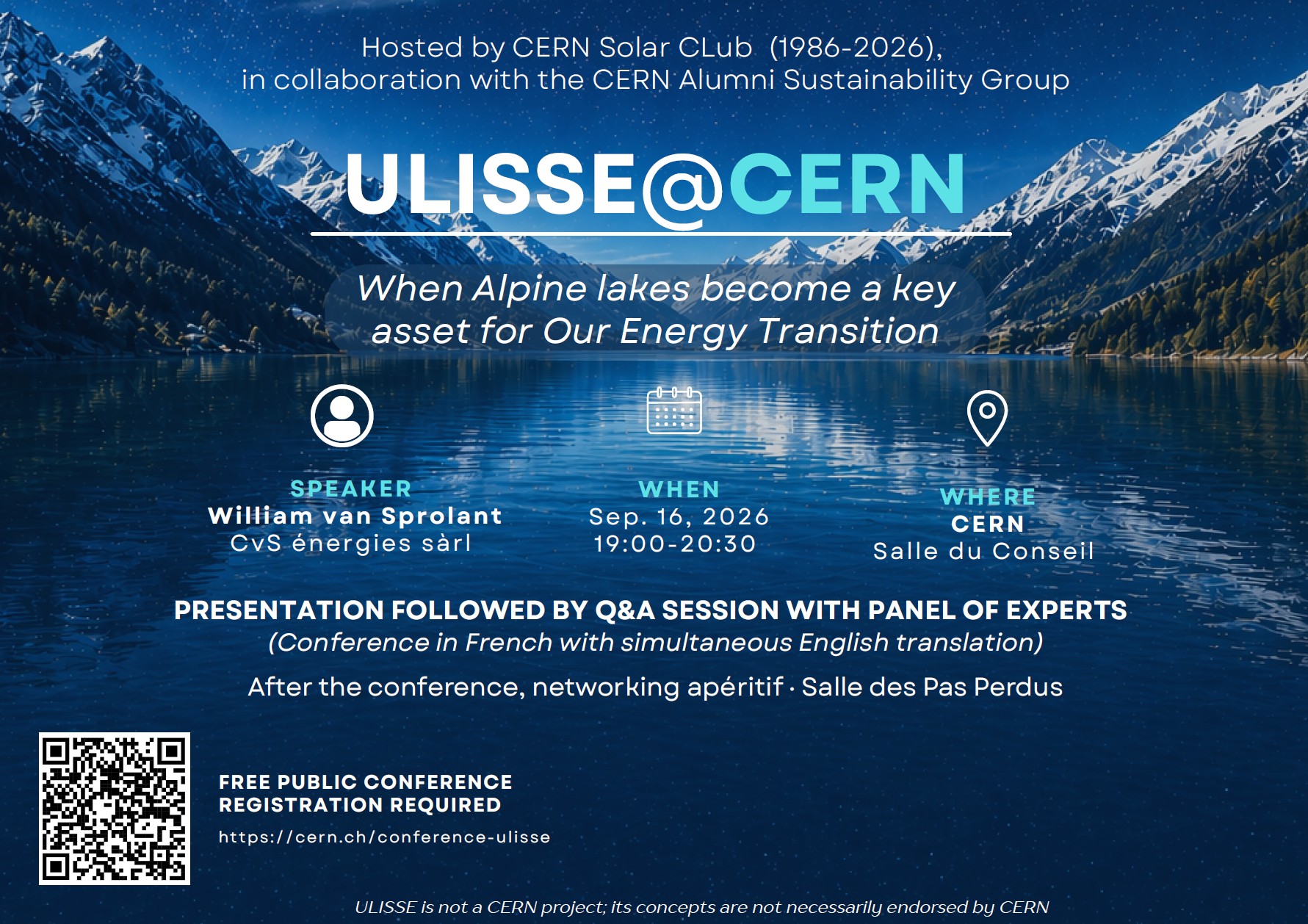
When Alpine lakes become a key asset for our Energy Transition
Date: 16 September 2026, 19:00-21:15
Location: CERN, Salle du Conseil, 503/1-001, Go to map
Speaker: William van Sprolant, CvS énergies sàrl
Presentation followed by Q&A session with panel of experts
After the conference, networking apéritif (Salle des Pas Perdus)
Background information:
Nearly 200 countries, including Switzerland and France, have signed the Paris Climate Accords which aims to phase out fossil fuels by 2050. This global energy transition relies increasingly on electricity to meet transportation, heating, and cooling needs as well as decarbonisation of industry, through renewable energy sources. In this context, Switzerland forecasts a 20 % shortfall in native electricity for the winter semester of 2050 - the opposite of the summer semester - and equivalent to the historical capacity of its hydroelectric storage dams (9 TWh). The seasonal storage of renewable energy will be an essential adaptive key.
The Alpine region, already impacted by global warming (glacier retreat, landslides, torrential floods, and lake eutrophication), nevertheless possesses a major additional asset for thermal energy storage through its large lakes.
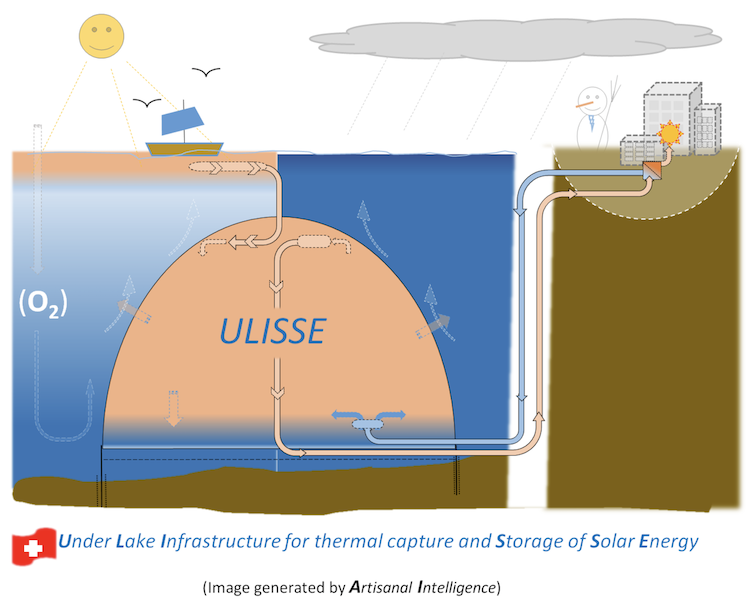
The ULISSE (Under Lake Infrastructure for Thermal Capture and Storage of Solar Energy) system is a network of large sub-lake reservoirs (1 M m3/unit) for the seasonal storage of solar and waste heat (air-conditioning, datacentres, etc.), with the aim to preserving or restoring deep-water oxygenation and nutrient circulation vital to the ecosystem of large Alpine lakes, while reducing winter electricity consumption for the surrounding Thermo-Lacustrine Networks (TLN) used for urban cooling and heating. With the development of TLN, the implementation of ULISSE in Switzerland’s 15 largest lakes, could potentially reduce by a third [3 TWh*] of the 9 TWh projected national structural electricity deficit for the winter semester of 2050.
The exploratory study for the ULISSE project, funded by the Swiss Federal Office of Energy (SFOE), was conducted at Geneva's University of Applied Sciences (HEPIA, 2021–2023), Today, the ULISSE project is in the process of forming a public-private advanced research consortium, followed by a demonstration pilot in 2030.
[3 TWh* ≈ 750’000 Swiss households annual electricity consumption; = 2 + 1 TWh from the “winter preheating” (without heat pump) of the drinking water networks outside lake regions]