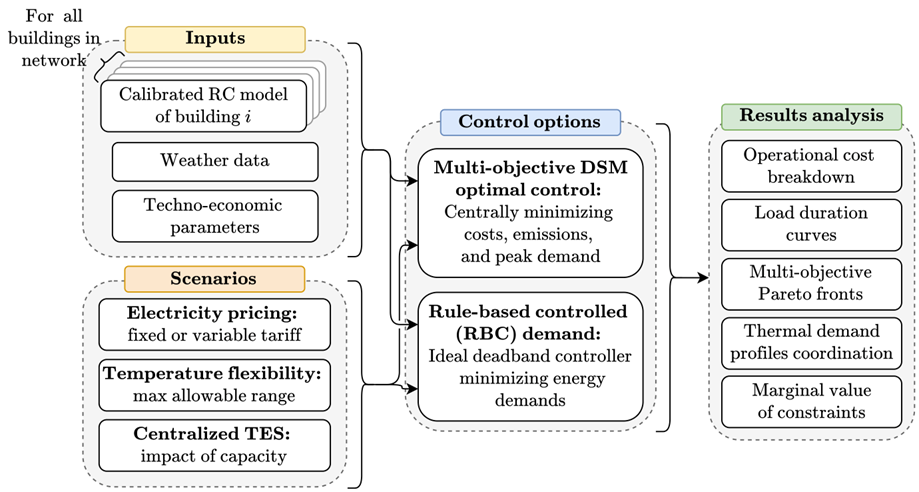
Optimizing integrated district heating and cooling (iDHC) networks requires operational flexibility. This study evaluates demand-side management (DSM) leveraging building thermal inertia against rule-based control (RBC) in a Zürich iDHC network.
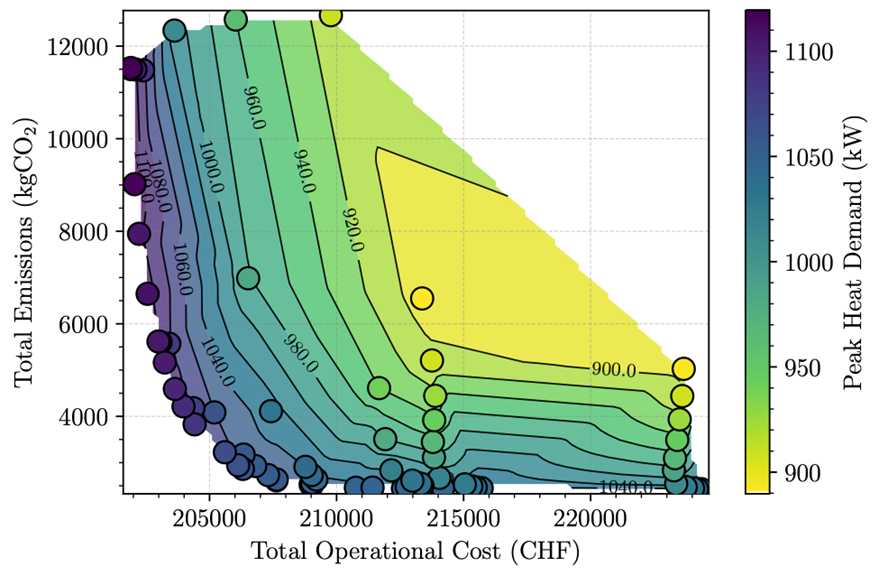
Multi-objective optimization shows DSM achieves a 6% cost reduction, a 90% emissions cut, and peak load shaving of 24.5% (heating) and 53.8% (cooling). However, optimizing individual metrics penalizes others, illustrated via Pareto surfaces.
Sensitivity analyses show dynamic tariffs and relaxed indoor temperatures enhance cost savings.
Furthermore, building thermal mass in the case studied is shown to be equivalent to around 800-900 kWh of distributed energy storage, potentially offsetting physical infrastructure investments in centralized storage.
Link to the journal paper at SSRN: