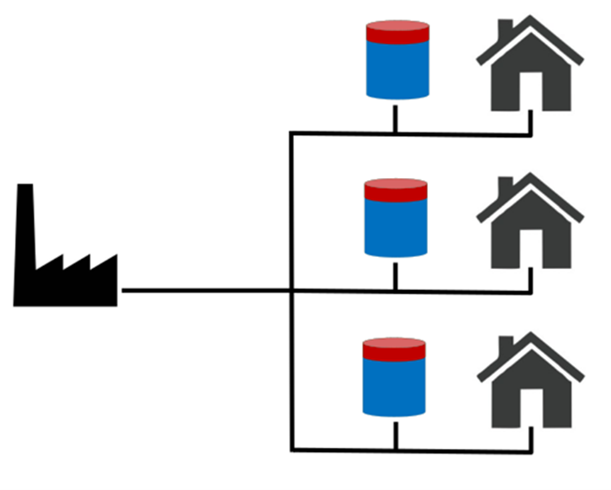
Decentralized heat storages — small thermal buffers installed at the customer level — have significant potential to reduce peak loads in district heating systems.
But do they actually deliver at the plant level?
Analysis of historical demand data from a district heating network in Zurich reveals a key insight: local optimization at individual customer sites alone has limited system-wide impact. Coordinated control across multiple storages is essential to unlock their full potential.
To address this, a scalable, machine-learning-based control policy is being developed that enables real-time coordination of decentralized storages across the network.
The goal: measurable reductions in plant peak loads, fossil fuel consumption, and overall system costs — contributing directly to the decarbonization of district heating.